

Bạn đang tìm kiếm nguồn tài liệu Reading bổ ích để vừa nâng band vốn từ, vừa cập nhật kiến thức về xu hướng năng lượng xanh toàn cầu? Đừng bỏ lỡ bài đọc số 10 trong chuỗi series Daily Reading hôm nay nhé!
Chủ đề Năng lượng tái tạo (Renewable Energy) luôn là chủ đề phổ biến trong các đề thi IELTS/TOEFL và các bài báo học thuật quốc tế. Hiểu sâu về nó không chỉ giúp bạn làm bài nhanh hơn mà còn xây dựng nền tảng kiến thức xã hội vững chắc!
Engonow.com
Bài đọc:
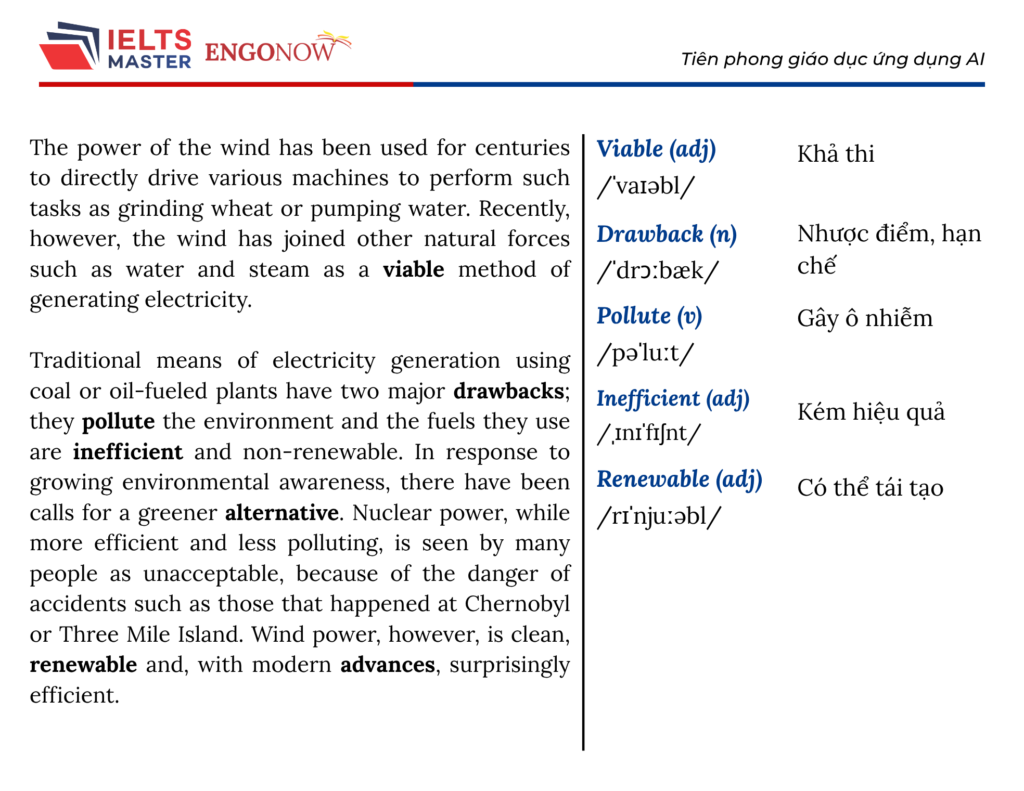
The power of the wind has been used for centuries to directly drive various machines to perform such tasks as grinding wheat or pumping water. Recently, however, the wind has joined other natural forces such as water and steam as a viable method of generating electricity.
Traditional means of electricity generation using coal or oil-fueled plants have two major drawbacks; they pollute the environment and the fuels they use are inefficient and non-renewable. In response to growing environmental awareness, there have been calls for a greener alternative. Nuclear power, while more efficient and less polluting, is seen by many people as unacceptable, because of the danger of accidents such as those that happened at Chernobyl or Three Mile Island. Wind power, however, is clean, renewable and, with modern advances, surprisingly efficient.
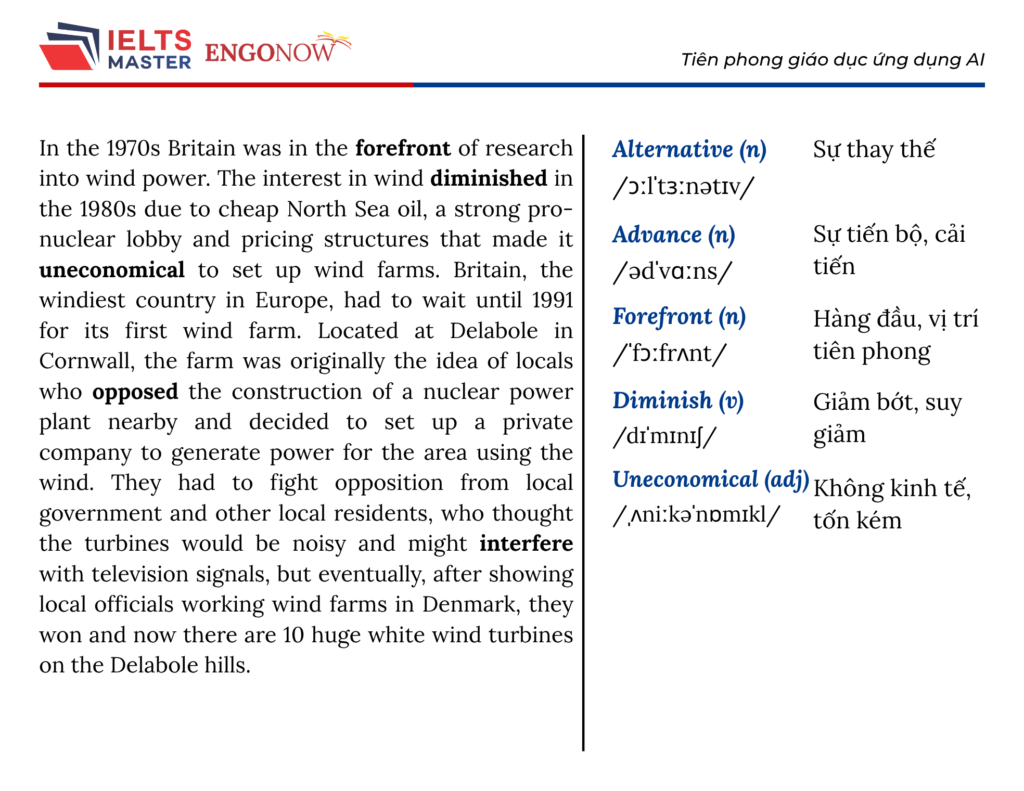
In the 1970s Britain was in the forefront of research into wind power. The interest in wind diminished in the 1980s due to cheap North Sea oil, a strong pro-nuclear lobby and pricing structures that made it uneconomical to set up wind farms. Britain, the windiest country in Europe, had to wait until 1991 for its first wind farm. Located at Delabole in Cornwall, the farm was originally the idea of locals who opposed the construction of a nuclear power plant nearby and decided to set up a private company to generate power for the area using the wind. They had to fight opposition from local government and other local residents, who thought the turbines would be noisy and might interfere with television signals, but eventually, after showing local officials working wind farms in Denmark, they won and now there are 10 huge white wind turbines on the Delabole hills.
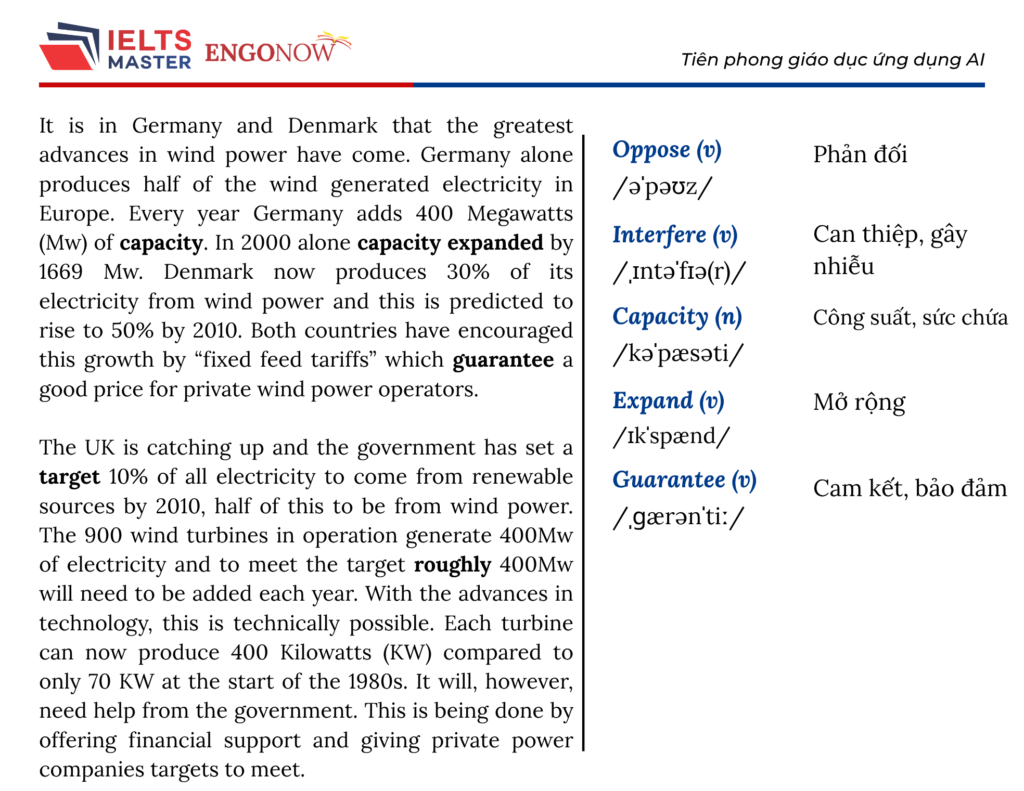
It is in Germany and Denmark that the greatest advances in wind power have come. Germany alone produces half of the wind generated electricity in Europe. Every year Germany adds 400 Megawatts (Mw) of capacity. In 2000 alone capacity expanded by 1669 Mw. Denmark now produces 30% of its electricity from wind power and this is predicted to rise to 50% by 2010. Both countries have encouraged this growth by “fixed feed tariffs” which guarantee a good price for private wind power operators.
The UK is catching up and the government has set a target 10% of all electricity to come from renewable sources by 2010, half of this to be from wind power. The 900 wind turbines in operation generate 400Mw of electricity and to meet the target roughly 400Mw will need to be added each year. With the advances in technology, this is technically possible. Each turbine can now produce 400 Kilowatts (KW) compared to only 70 KW at the start of the 1980s. It will, however, need help from the government. This is being done by offering financial support and giving private power companies targets to meet.
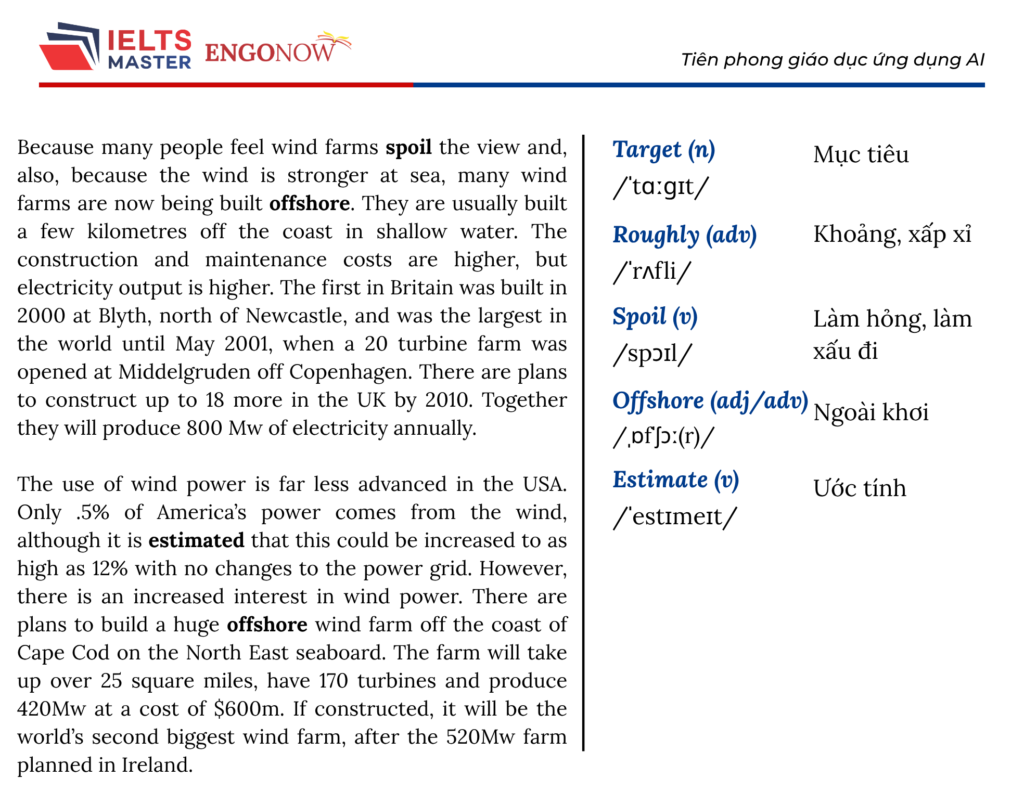
Because many people feel wind farms spoil the view and, also, because the wind is stronger at sea, many wind farms are now being built offshore. They are usually built a few kilometres off the coast in shallow water. The construction and maintenance costs are higher, but electricity output is higher. The first in Britain was built in 2000 at Blyth, north of Newcastle, and was the largest in the world until May 2001, when a 20 turbine farm was opened at Middelgruden off Copenhagen. There are plans to construct up to 18 more in the UK by 2010. Together they will produce 800 Mw of electricity annually.
The use of wind power is far less advanced in the USA. Only .5% of America’s power comes from the wind, although it is estimated that this could be increased to as high as 12% with no changes to the power grid. However, there is an increased interest in wind power. There are plans to build a huge offshore wind farm off the coast of Cape Cod on the North East seaboard. The farm will take up over 25 square miles, have 170 turbines and produce 420Mw at a cost of $600m. If constructed, it will be the world’s second biggest wind farm, after the 520Mw farm planned in Ireland.
Từ vựng nổi bật:
- Viable (adj) /ˈvaɪəbl/: Khả thi
- Drawback (n) /ˈdrɔːbæk/: Nhược điểm, hạn chế
- Pollute (v) /pəˈluːt/: Gây ô nhiễm
- Inefficient (adj) /ˌɪnɪˈfɪʃnt/: Kém hiệu quả
- Renewable (adj) /rɪˈnjuːəbl/: Có thể tái tạo
- Alternative (n) /ɔːlˈtɜːnətɪv/: Sự thay thế
- Advance (n) /ədˈvɑːns/: Sự tiến bộ, cải tiến
- Forefront (n) /ˈfɔːfrʌnt/: Hàng đầu, vị trí tiên phong
- Diminish (v) /dɪˈmɪnɪʃ/: Giảm bớt, suy giảm
- Uneconomical (adj) /ˌʌniːkəˈnɒmɪkl/: Không kinh tế, tốn kém
- Oppose (v) /əˈpəʊz/: Phản đối
- Interfere (v) /ˌɪntəˈfɪə(r)/: Can thiệp, gây nhiễu
- Capacity (n) /kəˈpæsəti/: Công suất, sức chứa
- Expand (v) /ɪkˈspænd/: Mở rộng
- Guarantee (v) /ˌɡærənˈtiː/: Cam kết, bảo đảm
- Target (n) /ˈtɑːɡɪt/: Mục tiêu
- Roughly (adv) /ˈrʌfli/: Khoảng, xấp xỉ
- Spoil (v) /spɔɪl/: Làm hỏng, làm xấu đi
- Offshore (adj/adv) /ˌɒfˈʃɔː(r)/: Ngoài khơi
- Estimate (v) /ˈestɪmeɪt/: Ước tính
IELTS Master powered by Engonow
Enlighten Your Goal Now.
Quận 6 – Bình Tân, TP HCM / Online toàn cầu.
engonow.edu.vn
Xem thêm:[DAILY READING #8]: DEPRESSION